

The Conversation
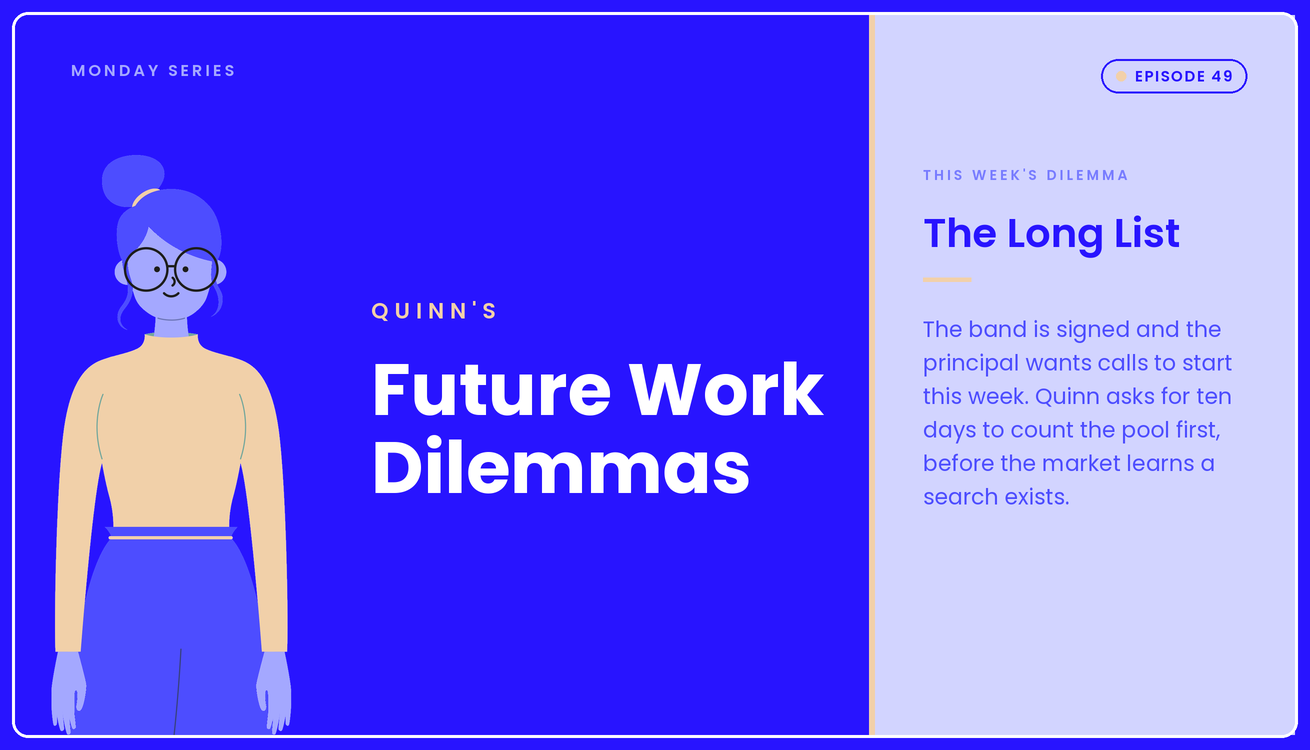
The band is signed. The seat has a shape, a number the principal can defend without borrowing one, and a signature at the bottom of a single page. The principal treats the signature as momentum and wants to spend it. The first calls should go out this week.
Quinn asks for ten days and spends them counting.
The morning outreach begins, the market starts learning that a search exists. Until then, the search can study the market while the market knows nothing. That is the only stretch of the engagement when attention costs nothing, and Quinn will not spend it dialing the first name that comes to mind.
What Quinn Weighs
Three moves suggest themselves, and each fails in its own way.
The first is to start with the obvious names. Every market carries a handful of them, the people who surface at every dinner where a seat like this is discussed. They are real candidates and terrible starting points. Whoever calls them joins the queue of every search that started the same way, and a first-build seat is rarely won by the market's most decorated resume.
The second is to go wide. A posting, a mandate to two agencies, a broad sweep that promises coverage. It buys volume and pays in discretion. The seat's existence becomes public knowledge in a week, candidates begin pricing the family's urgency, and the household learns about its next hire from a forwarded link.
The third is to pull a list by title. Databases price titles the way surveys do, and this seat barely has one. The people who can do the work sit under other labels: a chief of staff carrying operations, a foundation director running a family's whole apparatus, an estate professional who outgrew the property. A title query returns the org charts of other companies.
The move that works is slower and dull on purpose. Count the whole pool first, in silence, then decide which conversation happens first.
Quinn's Challenge
Two tensions sit inside the counting. The first is discretion. Every outbound question that carries the seat's name is an announcement, so the census has to be assembled from what can be learned without asking directly. The second is the stopping problem. A list can grow for as long as anyone keeps feeding it, and a search can hide inside its own research for a month. A census needs an edge, a rule that says the map is finished and the calling can start.
The Framework: The Census
Quinn builds the long list in three moves, in order.
1. Draw the borders. One page defines where the pool ends: the three adjacent titles the work hides under, the sectors that train people for it, the geographies the family can draw from, and the band the page must respect. The borders make counting possible. Everything outside them is excluded on purpose, in writing.
2. Count in silence. Names come from placement patterns, published moves, peer maps, and the two pattern-level calls Quinn allows herself, neither of which carries the seat's name. Every name that fits the borders goes into the table, however unreachable it looks. The stopping rule is fixed in advance: when three independent sources stop producing new names, the census is done.
3. Date every row. Each name gets two entries: what would have to be true for a move, and the earliest date it could be true. A vesting schedule, a bonus landing in March, a season ending in October. The dates do the sorting. Merit decides order within a tier; the calendar decides the tiers.
What Quinn Does First
Quinn writes the borders page and reads it against the signed band from the week before. The two documents discipline each other. A border drawn too senior collides with the band's ceiling, and the collision surfaces now, on paper, rather than in a candidate's kitchen in November. Names the band cannot reach still go into the table, marked as out of reach, so nobody spends a week courting a person the budget retired in advance.
How Quinn Builds It
The census is a table, one row per name: current seat, why the work fits, what would have to be true, and the date. It takes nine days. By the end the table holds thirty-one names. Nine could move this quarter. Eleven carry dates in the first quarter of next year, bonus calendars mostly. The remaining eleven are references in waiting, people who will never sit in this seat and know everyone who might. Quinn marks that third group as carefully as the first. A census pays out twice, in candidates and in the people who can vouch for them.
The Outcome
Quinn walks the principal through the table. "I thought there would be more." It is said quietly, and it changes the meeting. Thirty-one names, nine reachable before the new year, a page where scarcity stops being an argument and becomes a number the family can plan against. The signed band reads differently beside it. So does the calendar.
The first call goes out on the tenth day, to a name that had appeared in none of the dinner conversations, chosen because her date was now and her reasons were real.
The answer came back inside a week. It was a no.
A Direct Plan for Operators
Week one: write the borders on one page. The three titles the work hides under, the sectors that train for it, the geography you can genuinely draw from, and the band the page must respect. Week two: build the table without outbound noise, one row per name, each carrying what would have to be true and the earliest date it could be. Stop when three sources stop adding names. Week three: sort by date, choose the first five conversations, and sequence them so the market's loudest corner hears about the search last. Keep the table alive after the calling starts. Every conversation updates a row, and the table is what the next search inherits.
Operating Principles
The pool is counted before it is contacted.
Every early call spends discretion the search will want later.
The strongest name on a long list usually sits under a different title.
A census is finished when three sources stop adding names.
A date on every row turns a list into a plan.
Quinn's Note to Operators
The census earns its keep in the meeting where the market becomes a page the principal can hold. Before that meeting a search runs on hope, and hope negotiates badly. After it, the search runs on a calendar, and calendars are hard to argue with. The ten slow days at the start are the reason the fast weeks later exist.
Next Episode: The First No
What Quinn learns when the strongest reachable name declines.
Every other Monday
Quinn works through one hiring dilemma at a time. Leave an address and the next one arrives when it is written.
 ©2026 Talent Gurus Inc. All rights reserved.