

The Conversation
The brief exists now. It was written the hard way, one discovery meeting at a time, and the seat finally has a shape: a first senior operator for a family office that has run on the principal and two assistants for a decade.
What it does not have is a price.
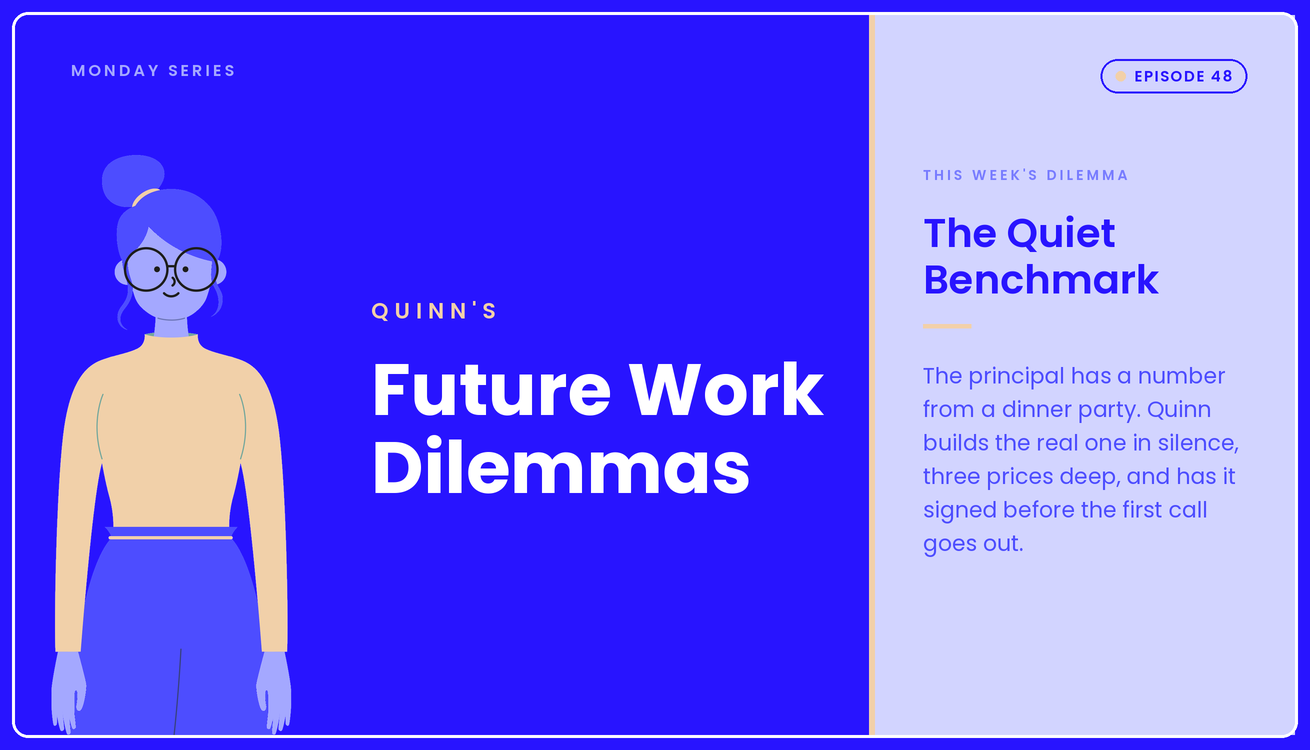
The principal is not worried. "My neighbor pays his man two hundred." The number arrived over dinner, attached to a different office, a different city, and a different year. It has already survived two follow-up conversations, which is how borrowed numbers become budgets.
Quinn has a rule for this moment. The search does not open until the seat carries a number the principal can defend without borrowing one. Because the number is the last quiet thing about a search. The morning the first call goes out, everyone else starts pricing the seat, and they do not price it kindly.
What Quinn Weighs
There are three easy moves, and each one fails in its own way.
The first is to take the dinner number. It is free, it is already believed, and it is wrong in every dimension that matters. Worse, it will be defended emotionally, because it came from a peer rather than a page.
The second is to ask candidates what they expect. This feels like research and is actually surrender. Whoever states a number first sets the anchor, and a benchmark assembled from candidate expectations is not a benchmark. It is the opening position of a negotiation the principal has already joined without noticing.
The third is to commission the broad survey. Surveys price titles, and this seat barely has one. The data lags a year, the comparables are corporate, and the commissioning itself tells a vendor that a search exists.
The move that works is slower and quieter. Price the seat from inside, in three directions, before the market learns there is anything to price.
Quinn's Challenge
The tension is not finding the number. It is when the number exists. A benchmark set before the market speaks is a policy. The same benchmark set after a candidate quotes their agent is a concession with paperwork. And the work must be done in silence, because every comp call placed under the seat's real name is an announcement.
The Framework: The Three Prices
Quinn prices the seat three ways, in order.
1. Price the work. What does the seat replace: the fragmented vendor spend, the assistant hours, the principal's own evenings, the cost of the errors nobody has attached a number to. This sets the ceiling the family can justify to itself.
2. Price the market. Not the title, the three nearest seats. Placement data first, published percentiles second, adjusted for scarcity and for the discretion this household requires. This sets the band: floor, midpoint, ceiling, each with a one-line reason.
3. Price the move. The person who says yes will leave money behind: deferred comp, a vesting date, a bonus that lands in March. This does not change the band. It decides where inside the band an offer has to land to be a real offer.
What Quinn Does First
Quinn pulls the percentile data for the three nearest seats and costs the work the seat absorbs. Nothing outbound carries the role's name. The two calls she does place are pattern-level, peer to peer, about what discretion is pricing at this year, and neither peer learns a search exists.
How Quinn Builds It
The benchmark fits on one page. Three prices, one band, and a line at the bottom for a signature. The dinner number is on the page too, labeled as what it is: an anchor from another market, listed so it can be retired in daylight rather than whispered in week five.
Then the principal signs the band, before the first candidate hears the role exists. The signature is the mechanism. When a strong candidate eventually quotes high, the conversation happens between the candidate and the page, not between the candidate and the principal's nerve.
The Outcome
Five weeks in, the strongest candidate arrived carrying an agent's number, forty percent above ceiling. The earlier version of this principal would have split the difference and resented it by spring. This one read the page. The offer landed mid-band, structured around the candidate's vesting dates, and was accepted within the week.
The dinner number never came up again.
A Direct Plan for Operators
Week one: write down what the seat replaces and cost it honestly, including your own hours. Week two: pull three comparable seats, not one title, and set floor, midpoint, and ceiling with a written reason for each. Week three: price the exit of the person most likely to say yes, mark where inside the band an offer must land, and get the band signed by whoever owns the budget, before any candidate hears the role exists. After that, never quote the band. Let offers land inside it, and reopen it only if two finalists decline for the same stated reason.
Operating Principles
A number set before the market speaks is a policy. Set after, it is a concession.
Benchmarks built during a negotiation belong to the negotiation.
Every comp call is an announcement. Price quietly or price publicly, but know which one you are doing.
The band needs a signature more than it needs precision.
Quinn's Note to Operators
The benchmark earns its keep in week five, when the market finally speaks and says something expensive. A principal who signs a band is buying their own steadiness in advance, at the only moment it is cheap. That is the whole trade.
Next Episode: The Long List
How Quinn maps the pool before the first call goes out.
