
The Conversation
The hire started three months ago. The onboarding went well. The first principal meeting was promising. The first two weeks were better than promising.
Then the signal changed. A meeting ran longer than it should. A decision that should have been clean got revisited. The candidate was good. The seat needed something different.
The principal calls on a Tuesday.
The tone is measured. It is the tone people use when they have already made up their mind but still want the conversation.
"This is not your fault. But I want to understand what happened."
Quinn recognizes the sentence. It is the most honest thing a principal can say when a hire does not work. It is also the moment most operators over-correct. They apologize too much, rebuild their pitch too fast, or pivot straight to the replacement search without acknowledging the gap.
Quinn does none of those things. She takes the conversation seriously, because the question is serious.
What Quinn Weighs
A failed hire is rarely a single cause. The search process, the fit calibration, the onboarding, the principal's own pattern of expectations, each contributes. Untangling them matters, because the replacement will go the same way if the analysis is shallow.
Defensiveness is the most expensive response. It preserves the process at the cost of the relationship.
Over-apologizing is almost as bad. It signals that every future search carries the same uncertainty, which makes the principal braced rather than engaged.
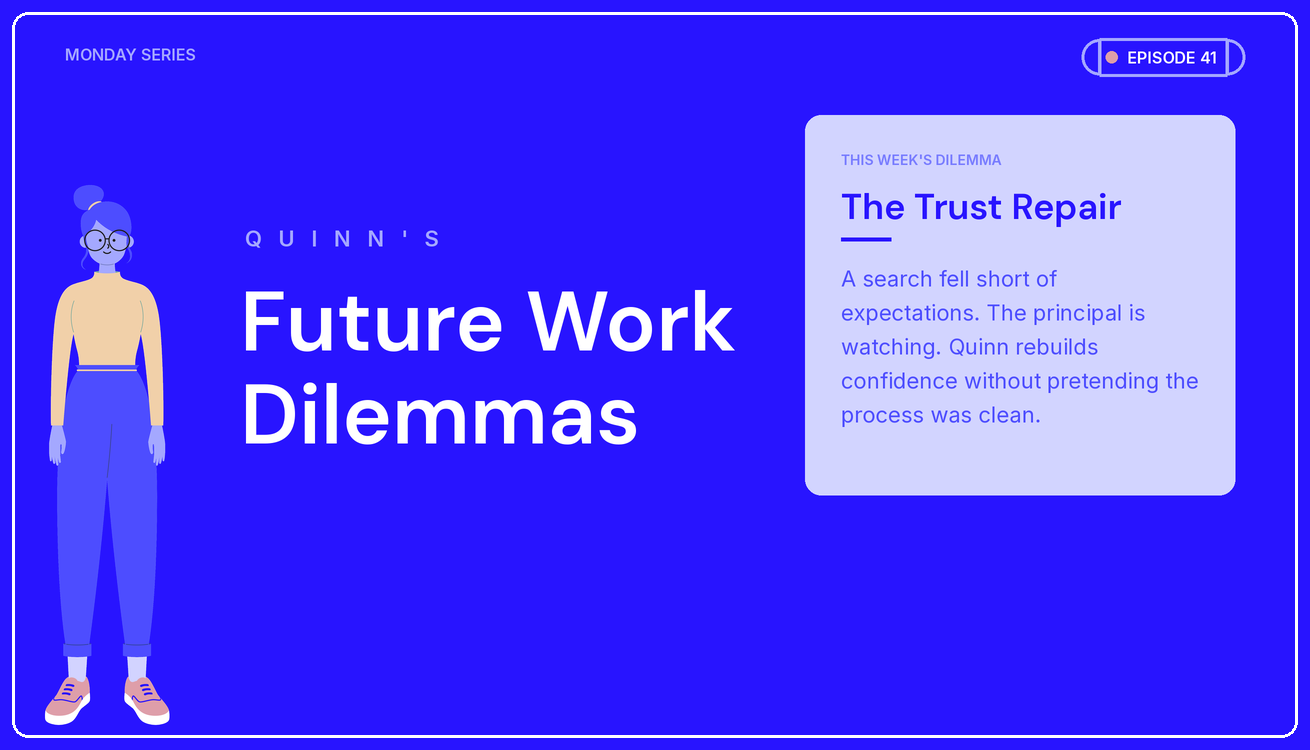
Quinn's priority: make the breakdown legible, own what was hers to own, and re-anchor the relationship on a clearer understanding of what went wrong.
Quinn's Challenge
The principal is not asking for a post-mortem document. They are asking whether to trust the next search. That is a harder question than process analysis.
The answer is built in three moves, not in one meeting.
The Framework Quinn Uses
Quinn calls it the Trust Repair Pass. It has three parts.
1) Name the Gap Precisely
Quinn writes the miss in one paragraph. No hedging, no process language. What the brief called for, what the candidate delivered, where the two separated.
The paragraph is short. Three or four sentences. It is read once and held.
2) Separate What Was Foreseeable from What Was Not
Some misses are search errors. Others are post-offer dynamics that no diligence surfaces. A partner's relocation, a family event, a quiet change in the principal's own thinking.
Quinn separates them. She owns the search errors without diluting them. She names the non-search variables without using them as cover.
3) Show the Adjustment
A trust repair fails if it stops at apology. The principal needs to see the change, not hear the promise. Quinn brings one concrete adjustment to the next search. A structural sourcing change. A new reference protocol. A revised fit assessment. Something she would do differently whether or not this conversation happened.
What Quinn Does First
She asks the principal for the specific moment the gap became clear. Not the symptoms. The moment.
The answer is usually a specific conversation or decision point. That moment becomes the anchor for the repair. Everything else is built around it.
She does not schedule the post-mortem immediately. She gives the principal forty-eight hours. Pressure compresses thinking, and the most useful signal often arrives on the second day.
How Quinn Manages the Transition
Between the failed hire and the next search, there is a quiet window. Quinn uses it deliberately.
She updates the search document to reflect what she now knows about the principal's actual priorities. These are almost always different from the formal brief. The failed hire made them visible.
She revisits the candidate pool from the original search. Not to resurface the runners-up, which is a different mistake, but to understand what the sourcing found versus what the role actually needed. The delta is instructive.
She has a single conversation with the principal before restarting. Short. Specific. Anchored on the adjustment she is making, not the apology she is offering.
The principal responds the same way good principals always do when the answer is precise.
"That is the part I was trying to articulate. Thank you."
The Outcome
The next search starts with a tighter brief and a principal who has seen Quinn take responsibility in public. That is the repair. Not a perfect apology. A visible adjustment.
The candidate slate looks different. Fewer profiles, held to a sharper test. The principal engages earlier in the process because the trust is being rebuilt through participation, not through promises.
The replacement hire closes in fourteen weeks. The principal's confidence returns not because the second hire is flawless, but because the process was visibly better.
Trust does not come back by explanation. It comes back by correction.
A Direct Plan for Operators
For operators managing a failed-hire aftermath, Quinn's method keeps the relationship intact.
Day 1: Acknowledge the gap. One paragraph, written, not spoken.
Day 2 to 3: Wait. Give the principal space to think.
Day 4: Have the specific conversation. Ask for the moment, not the symptoms.
Day 5 to 6: Document the adjustment you are making. Structural, not cosmetic.
Day 7: Restart the search with the revised brief and the adjustment visible.
Operating Principles
- A failed hire is an information event, not a judgment event.
- The repair is the adjustment, not the apology.
- Trust rebuilds through participation, not promises.
- The next search is the first proof, not the second chance.
Quinn's Note to Operators
The principals who matter will tell you when a hire does not work. The ones who do not tell you are already moving the mandate elsewhere. When the conversation comes, treat it as the mandate itself.
Repair is a search deliverable. Not a relationship side quest.
Next Episode: The Silent Exit
How Quinn manages the read-across when a senior hire resigns without a clean reason.