
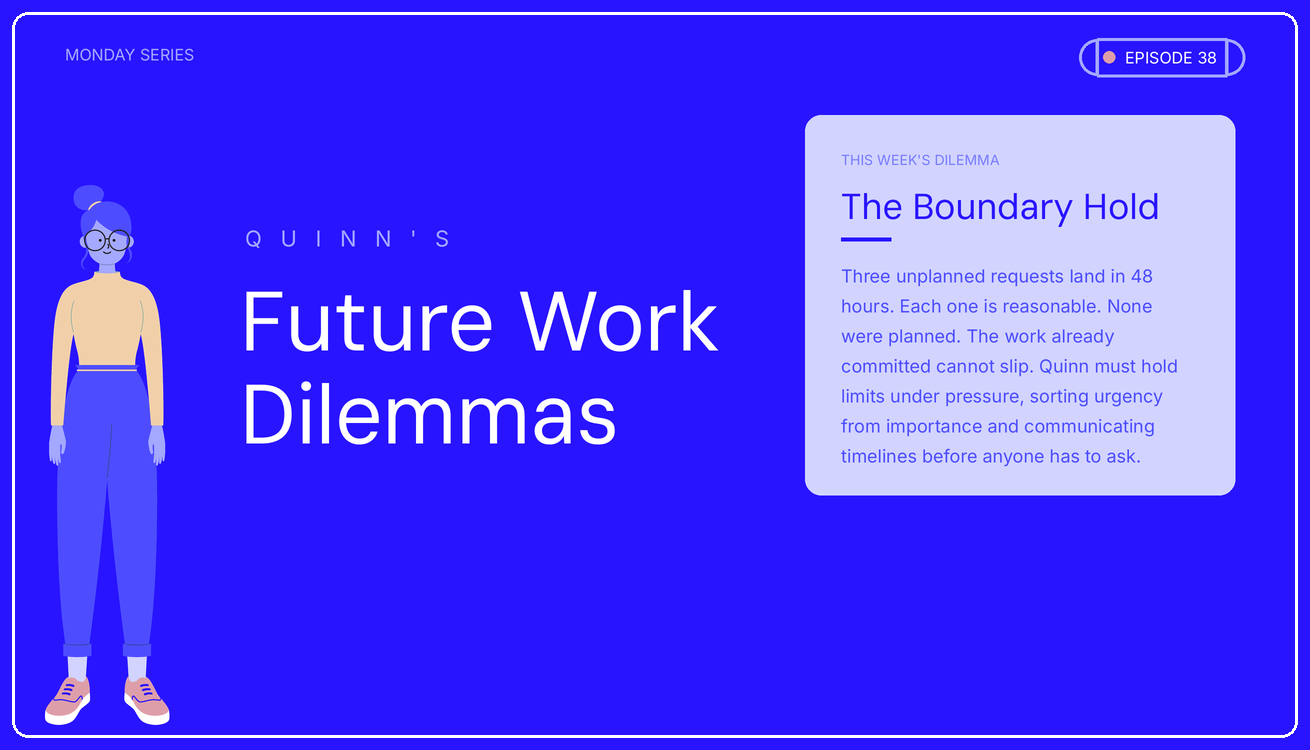

The Week Shifts
Monday starts clean. Two priorities locked. Timelines set. Ownership clear.
By Wednesday, three new requests arrive.
A principal needs a compensation analysis for a role that was not on the radar. A colleague asks Quinn to sit in on interviews for a separate search. An external partner sends materials that need review before a Friday call.
Each request is reasonable. Each one comes from someone whose time matters. None of them were part of the plan.
Quinn reads through all three. She does not respond immediately.
The instinct is to say yes. To absorb. To stretch the week until everything fits.
Quinn knows where that leads.
What Quinn Weighs
Family offices run on trust. Responsiveness signals reliability. Saying no feels like dropping the standard.
But saying yes to everything drops a different standard. The work already committed starts to slip. Quality thins. Deadlines stretch quietly. Nobody announces the cost, but it compounds.
Quinn sits with the tension.
Accept everything, and the committed work degrades.
Refuse outright, and relationships strain.
Ignore the requests, and they escalate.
Her priority is clear. Protect what is already in motion. Then sequence what arrives.
Quinn’s Challenge
The three requests are not equal. But they feel equal because they arrived at the same time with similar urgency in the sender’s tone.
One is time-sensitive. One is important but flexible. One is neither, though the sender believes otherwise.
Sort them wrong, and the truly urgent one waits while the flexible one gets immediate attention.
Treat them all as urgent, and the committed work suffers across the board.
Quinn chooses deliberate triage. She will hold the boundary on committed work, sequence the new requests by actual urgency, and communicate timelines before anyone has to ask.
The Framework Quinn Uses
Quinn applies a straightforward structure when demands exceed capacity. Not rigid. Practical.
She calls it the Boundary Guide. It has three parts.
1) Committed Work First
Quinn protects what is already in motion before accepting anything new.
- Current priorities reviewed. Status confirmed. Nothing deferred silently.
- Deadlines for committed work do not move to accommodate new requests.
- If committed work is at risk, that surfaces first. Before anything else enters.
- Capacity is finite. Acknowledging that is not a weakness. It is accuracy.
The work that was promised gets delivered. That is the baseline.
2) Triage by Evidence
Once committed work is secured, Quinn sorts new requests.
- Time sensitivity verified. Not assumed from tone.
- Impact assessed. Who is affected if this waits 48 hours? A week?
- Dependencies mapped. Does anything else stall without this?
- Effort estimated honestly. Not optimistically.
Urgency is a fact, not a feeling. Quinn separates the two.
3) Communicate Before They Ask
Quinn sets expectations proactively.
- Each requester gets a response with a timeline. Not an apology. A plan.
- If the answer is not this week, she says when.
- If the request needs to be restructured to fit, she offers the alternative.
- No silence. No vague promises. Specific next steps with dates.
People accept boundaries when the boundaries come with clarity.
What Quinn Does First
She reviews the committed work. Confirms nothing has slipped. Confirms the deadlines are still real.
Then she reads the three requests again. Slowly.
The compensation analysis has a meeting attached to it on Friday. That is time-bound.
The interview support is for next week. Flexible.
The partner materials are a courtesy review. Important to the relationship. Not urgent to the outcome.
Quinn maps a sequence: compensation analysis moves into this week’s plan, slotted into available capacity without displacing committed work. Interview support confirmed for next week with a specific time block. Partner review scheduled for Monday with a note sent today.
Three requests. Three timelines. Zero ambiguity.
How Quinn Manages the Pressure
The compensation analysis is tighter than expected. The data requires a second pass. Quinn adjusts her own schedule, not the committed work.
The colleague follows up about interview support. Asks if Quinn can join one session this week instead of next. Quinn checks capacity. There is no room without deferring something. She holds the line. Next week, as planned.
The partner sends a follow-up. Friendly. No pressure, but the implicit ask is clear.
Quinn responds the same day. Acknowledges the materials. Confirms the Monday review. Thanks them for the lead time.
No negotiation. No overexplanation. Just the plan, stated clearly.
By Friday, the committed work ships on time. The compensation analysis is complete. The other two requests are sequenced and confirmed.
Nothing was dropped. Nothing was rushed.
The Outcome
The committed work delivers on time. No quality compromises.
The principal gets the compensation analysis before the Friday meeting. Prepared, not scrambled.
The colleague has a confirmed time block for next week. Better than a distracted yes this week.
The partner gets a thoughtful review on Monday. Not a rushed glance on Thursday.
Nobody felt refused. Everyone felt informed.
The boundary was invisible to those outside it. But it held everything together inside.
A Direct Plan for Managing Demand
For operators facing more requests than capacity allows, Quinn’s method keeps quality intact.
Initial: Protect Committed Work
Review current priorities. Confirm status. Do not defer anything silently.
Mid: Triage Incoming
Sort by time sensitivity and impact. Separate urgency from tone.
Decision: Sequence and Communicate
Assign timelines. Respond to every requester with a plan, not a promise.
Follow-Up: Deliver as Stated
Ship on the timeline you set. Adjust only with notice.
Operating Principles
- Boundaries protect quality. Not convenience.
- Saying not yet is more useful than saying yes and delivering late.
- Urgency is a fact. Verify it before responding to it.
- Clarity prevents the friction that silence creates.
Quinn’s Note to Operators
Family office demands grow because the work is real and the trust is personal. Holding limits is not about distance. It is about delivering what you committed to before absorbing what arrives next.
Protect first. Sequence second. Communicate always.
Next Episode: The Quiet Audit
How Quinn reviews what is working without disrupting what runs.
.png)
