
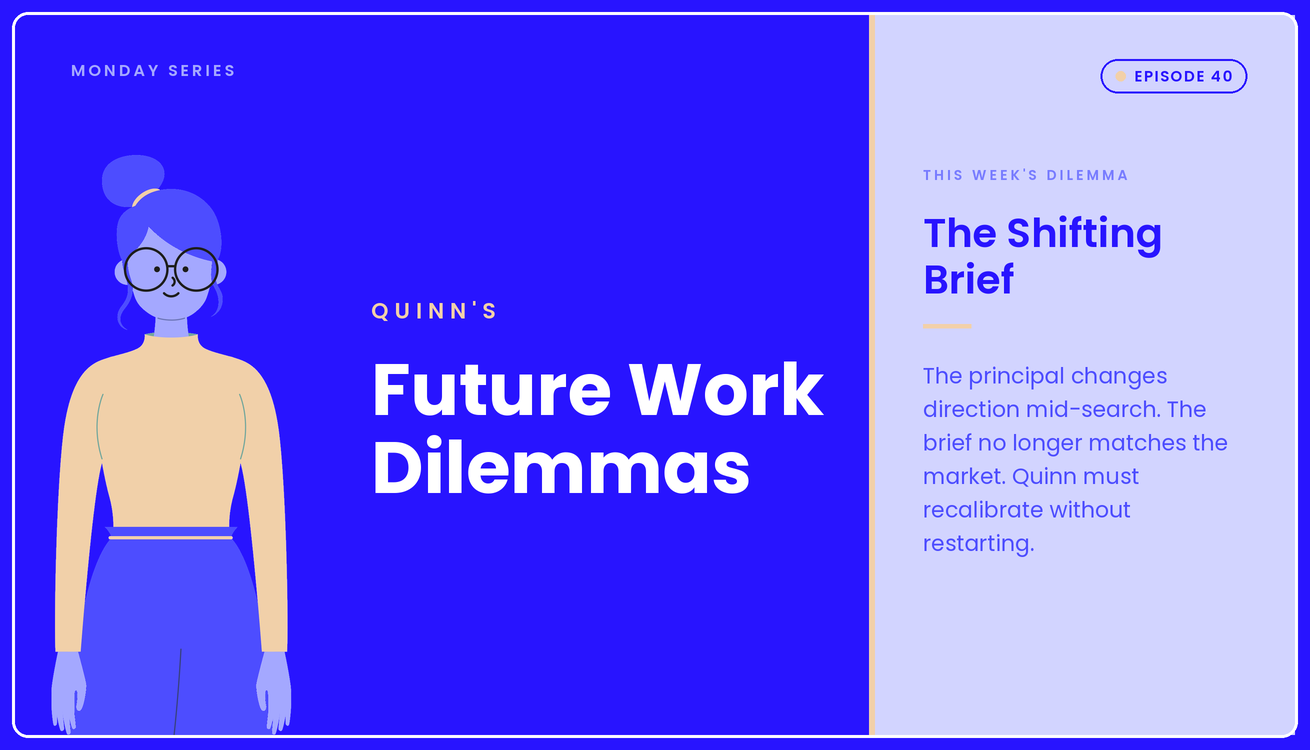

The Conversation
The search has been running for three weeks. Outreach is active. Two candidates are in early conversation. The brief is clear, the sourcing channels are mapped, and the timeline is on track.
Then the principal calls.
The role still needs filling. But the emphasis has changed. What started as a pure operations hire now requires investment oversight. The family's structure is evolving. The next person needs to bridge both.
"I know we are already moving. But this is where we are heading."
Quinn listens carefully. She does not push back. She does not agree immediately. She writes down exactly what changed and what stayed the same.
What Quinn Weighs
Shifting a brief mid-search is common in family offices. Principals think in real time. Their priorities are personal, and personal priorities evolve as circumstances do.
The risk is not the shift itself. It is how the shift is absorbed.
Reset entirely, and three weeks of progress disappear. Candidates already in conversation lose confidence in the process. The timeline doubles.
Ignore the shift, and the search delivers the wrong person. A hire that fit the old brief but not the current need. That is worse than a delay.
Force the old brief to stretch, and the result is a compromise candidate. Someone who partially fits both versions but fully fits neither.
Quinn's priority: recalibrate precisely. Keep what holds. Update what changed. Restart nothing unless the shift is fundamental.
Quinn's Challenge
The two candidates in conversation were sourced for the original brief. One may still fit. One may not.
The sourcing channels may need adjustment. Investment oversight draws from a different part of the market than pure operations.
The comp band may shift. Dual-scope roles command higher benchmarks.
Quinn needs to assess all three before a single new action.
The Framework Quinn Uses
Quinn applies a straightforward structure for brief changes. Not elaborate. Deliberate.
She calls it the Recalibration Guide. It has three parts.
1) Map the Delta
Quinn documents exactly what changed and what did not.
- Original brief captured in full.
- New direction stated precisely, in the principal's own words.
- Overlap identified: what requirements survive unchanged.
- New elements isolated: what is genuinely different.
The delta is usually smaller than it feels in the moment.
2) Reassess the Pipeline
Quinn evaluates current progress against the updated brief.
- Active candidates scored against new requirements.
- Candidates who still fit continue without disruption.
- Candidates who no longer fit are paused respectfully.
- Sourcing channels reviewed: does the new scope require different networks?
Progress is preserved wherever possible. Discarded only on evidence.
3) Reconfirm with the Market
Quinn checks the updated brief against market reality before moving.
- Comp band validated: does the new scope change the range?
- Scarcity reassessed: is the updated profile rarer or more available?
- Timeline re-estimated based on the recalibrated pool.
- Principal updated with market-informed expectations.
The brief must match the market. Not the other way around.
What Quinn Does First
She writes the delta in one page. Left column: original brief. Right column: updated brief. Middle column: what is the same.
The overlap is substantial. The core role, the location, the discretion requirements, the seniority level are all unchanged. What shifted is the scope: operations plus investment oversight, not operations alone.
She reviews the two active candidates. One has investment experience embedded in their background. The other is purely operational. The first continues. The second she pauses with a respectful note and a clear explanation.
How Quinn Manages the Transition
She checks comp data for the updated scope. A dual-mandate Family Office CEO with investment oversight sits higher than a pure operations CEO. P50 moves from $575K to approximately $650K. She confirms with market benchmarks before surfacing the number.
She reviews sourcing channels. The original channels still apply, but she adds two: a PE-adjacent network and a CFA-credentialed pool that the original search did not require.
She updates the principal with a single document. What changed, what held, what the market says about the new shape, and the revised timeline.
No drama. No restart narrative. Just the updated plan, stated clearly.
The principal reads it and responds the same day.
"This is exactly right. Keep moving."
The Outcome
The search continues with minimal disruption. One candidate advances. Two new candidates enter from the expanded sourcing channels.
The timeline extends by two weeks. Not three months. Because the shift was absorbed precisely, not reactively.
The principal's confidence in the process holds. They changed direction and the search adapted without losing ground. That is the test.
The brief shifted. The progress did not.
A Direct Plan for Brief Changes
For operators handling scope changes mid-process, Quinn's method preserves momentum.
Day 1: Document the Delta
Write what changed and what stayed. Be precise.
Day 2-3: Reassess the Pipeline
Score active candidates against the new brief. Pause or continue on evidence.
Day 4-5: Reconfirm with the Market
Check comp, scarcity, and channels for the updated scope.
Day 5: Update the Principal
One document. What changed, what the market says, and the revised plan.
Operating Principles
- Briefs shift because principals think in real time. That is normal.
- Recalibration is not restarting. It is precision under motion.
- Preserve progress wherever the evidence supports it.
- The market validates the brief. Not the other way around.
Quinn's Note to Operators
Family office priorities are personal. Personal priorities evolve. The operator's job is not to resist the shift. It is to absorb it without losing what was already built.
Map the delta. Protect the progress. Move forward.
Next Episode: The Trust Repair
How Quinn rebuilds confidence after a process falls short of expectations.
Every other Monday
Quinn works through one hiring dilemma at a time. Leave an address and the next one arrives when it is written.
 ©2026 Talent Gurus Inc. All rights reserved.