
The Smooth Surface
Four months in, the office runs well.
Handoffs are clean. Timelines hold. The team operates without excess discussion. Boundaries are respected. Work ships.
Quinn could leave it alone. Most operators would.
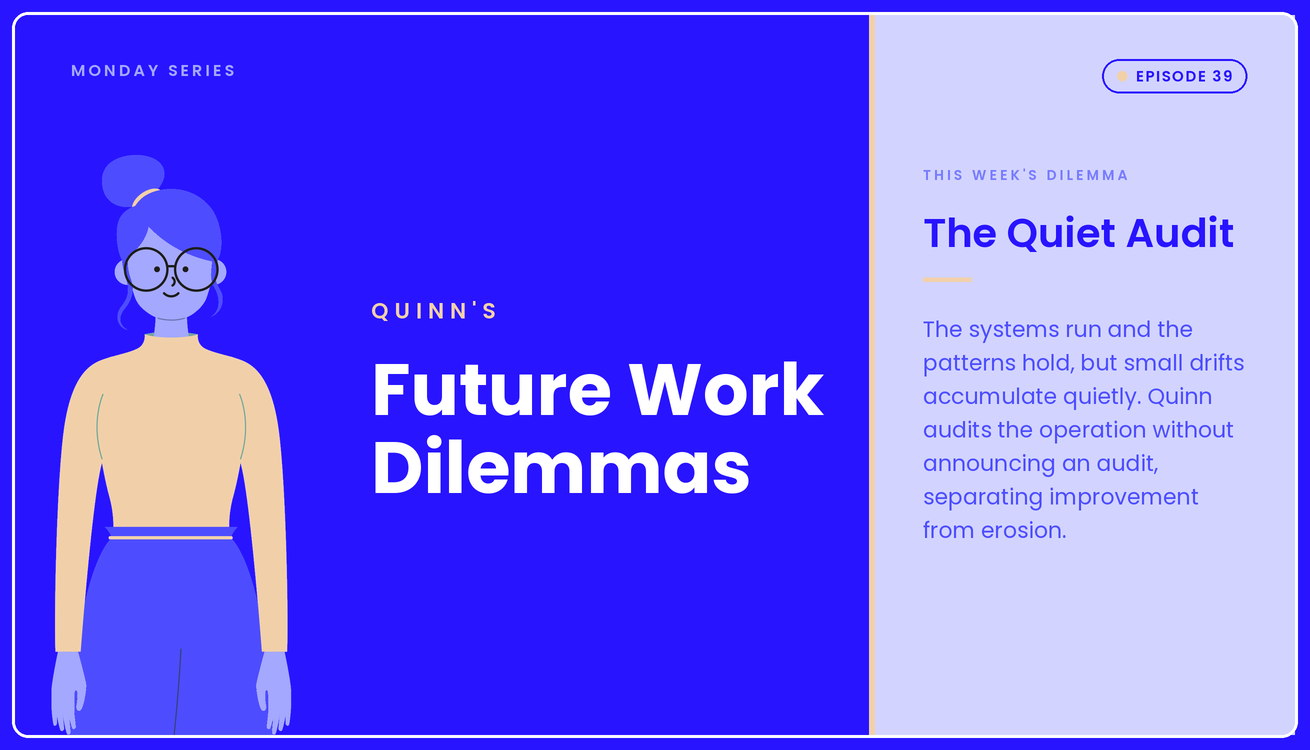
But she has seen what happens when smooth becomes assumed. Small deviations go unnoticed. A process that took three steps quietly becomes four. A response window that was 24 hours drifts to 36. Nobody flags it because nothing feels broken.
The gap between the original standard and current practice widens. Not fast. But steadily.
Quinn decides to audit. Quietly.
What Quinn Weighs
Announcing an audit changes behavior. People tighten up temporarily. The real patterns hide. Then they return the moment attention shifts.
Quinn needs to see operations as they actually run. Not as they perform under observation.
But reviewing without transparency risks trust. If the team discovers she was evaluating them silently, the relationship strains.
Her approach: observe openly, audit privately. She watches the work as it happens. She measures against documented standards on her own time. She shares findings as adjustments, not criticisms.
Quinn’s Challenge
Not everything that drifted needs correcting.
Some deviations are improvements. The team found a faster path. A step was redundant. The drift made things better.
Other deviations are erosion. A containment habit loosened. A documentation standard thinned. A response time stretched without cause.
Quinn’s job is to distinguish between the two. Keep the improvements. Correct the erosion. Touch nothing that does not need touching.
The Framework Quinn Uses
Quinn applies a straightforward structure for operational review. Not heavy. Invisible to the team until adjustments arrive.
She calls it the Review Guide. It has three parts.
1) Pattern Observation
Quinn watches the work for two weeks before changing anything.
- Handoff quality: are transfers still arriving complete?
- Response windows: are timelines holding or stretching?
- Documentation: are records as precise as the standard requires?
- Containment: are information boundaries holding under routine pressure?
She takes notes privately. No shared tracker. No visible process.
2) Standard Comparison
Quinn measures current practice against the documented standard.
- Each process compared to its original spec.
- Deviations categorized: improvement, neutral drift, or erosion.
- Improvements noted and preserved.
- Erosion flagged for correction.
The standard is the reference point. Not memory. Not feeling.
3) Single-Point Adjustment
Quinn corrects one thing at a time.
- One adjustment per week. Never a batch of fixes.
- Framed as refinement, not correction.
- Delivered through example first, then conversation if needed.
- Impact observed before the next adjustment.
Changing everything at once signals distrust. Changing one thing signals care.
What Quinn Does First
She pulls the standards she documented in her first weeks. The approach she wrote. The quality definitions. The response expectations.
Then she watches. Two full weeks of normal operations.
She notes three things: handoff completion rates are still strong. Documentation has thinned slightly on recurring tasks. Response windows on internal requests have stretched by about half a day.
The documentation drift is the one that compounds. She starts there.
How Quinn Makes the Adjustment
She does not announce a finding. She does not call a meeting.
She sends a clean, complete handoff note for her own next task. Full detail. Precise format. The standard she originally set, demonstrated again.
Then she mentions it in the next weekly sync. Casually. One line.
“I noticed I had gotten a bit loose on my own handoff notes. Tightened them back up this week.”
She owns the drift before pointing it outward. The team recalibrates without being told.
The following week, handoff notes across the team are back to standard.
No confrontation. No announcement. Just the adjustment, demonstrated and absorbed.
The Outcome
Documentation returns to standard within two weeks.
Response windows she monitors for another week. They tighten on their own once the documentation adjustment lands. The two were connected.
The improvements the team made on their own, she leaves alone. A faster filing path. A simplified check-in format. These were genuine gains.
Operations run at the original standard again. In some areas, better.
Nobody experienced an audit. Everyone experienced a colleague who kept the bar visible.
A Direct Plan for Quiet Reviews
For operators maintaining standards over time, Quinn’s method prevents erosion without disruption.
Week 1–2: Observe
Watch operations against documented standards. Note deviations privately.
Week 3: Categorize
Separate improvements from erosion. Preserve the former. Flag the latter.
Week 4: Adjust One Thing
Demonstrate the correction through your own work first. Then surface it lightly.
Ongoing: Repeat Quarterly
Quiet reviews every three months prevent drift from compounding.
Operating Principles
- Smooth operations are when drift starts. Not when it stops.
- Audit the standard, not the people.
- One adjustment at a time builds trust. A batch of fixes breaks it.
- The best review is the one nobody noticed.
Quinn’s Note to Operators
Family office standards hold because someone keeps measuring. Not loudly. Not visibly. Just consistently.
Review when things work. That is when it matters most.
Next Episode: The Shifting Brief
How Quinn adapts when the principal changes direction mid-search.