
The Conversation
The call comes three months into the new role. The operator is six weeks past the honeymoon, three weeks into the operating model review, and one month out from the first CIO seat opening.
The inherited team is intact. Most of them. The seat Quinn is being asked about was left empty before the operator arrived.
"I brought you in to make these calls. But I want to hear how you are making them."
The principal's sentence does two things at once. It grants the authority. It also asks for the evidence. The operator knows it. Quinn knows it.
A first hire in a new seat is not about the seat. It is about the hiring standard the new operator is willing to defend in public.
What Quinn Weighs
The operator has two paths and a third that looks like both. They can run the search with the principal's long-time advisor as co-pilot, which protects the relationship but dilutes the mandate. They can run it solo, which is clean but high-stakes if the hire does not hold. They can defer the search by three months while they learn the house better, which is safe but tells the principal the authority is still being handed to them rather than held.
None of these is the right answer on their own.
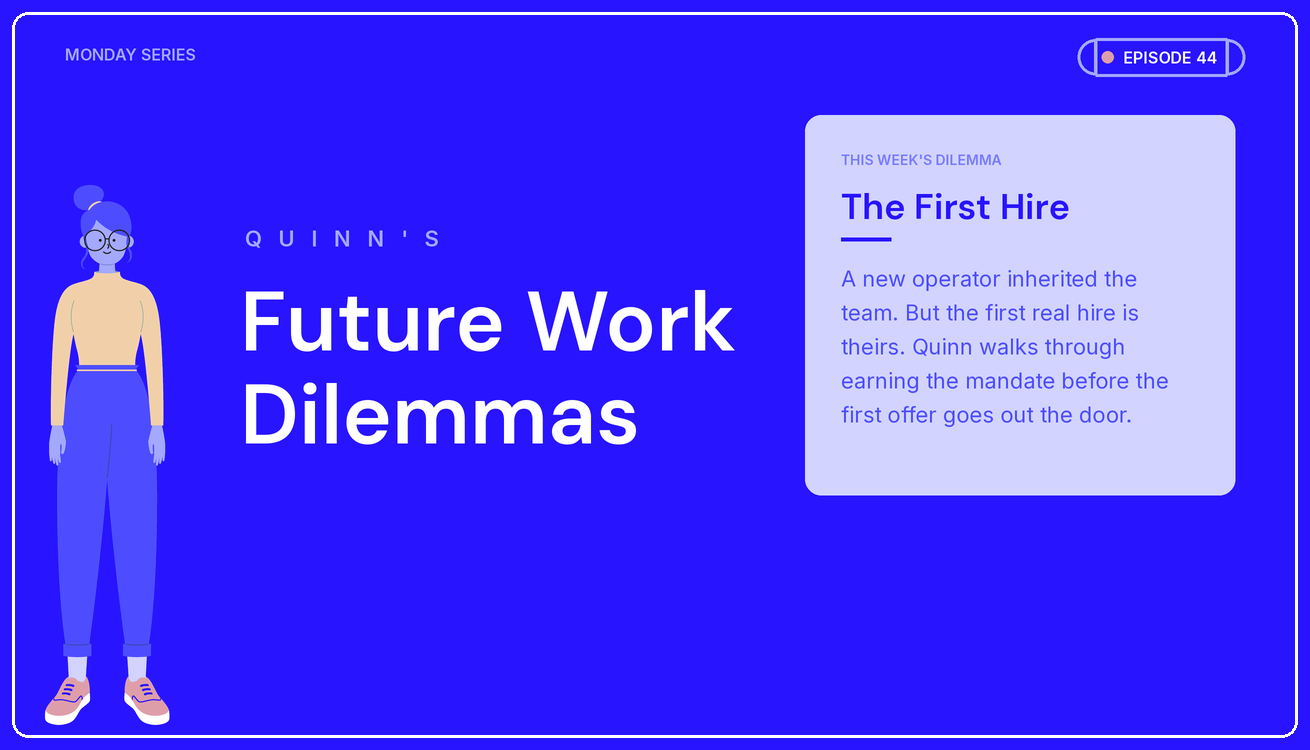
Quinn's priority: help the operator structure the search in a way that earns the mandate before the offer letter goes out, not after.
Quinn's Challenge
The long-time advisor has already recommended two candidates from their personal network. The candidates are good. The operator has not interviewed them yet. The principal is watching the first move more closely than they are watching the eventual hire.
The search has to surface a standard the operator sets, not a shortlist the advisor hands over.
The Framework Quinn Uses
Quinn calls it the First Hire Foundation. It has three parts.
1) Confirm the Mandate, Not the Brief
Quinn helps the operator have one conversation with the principal before sourcing begins. The conversation is not about the role. It is about the decision rights. Who signs off at which stage. Who sees which candidates. Who holds the no.
The mandate gets written down. One page. Both sides sign it in spirit, not in ink.
2) Establish the Hiring Standard in Public
The operator names the rubric out loud. Three criteria the seat has to meet, in priority order. The long-time advisor's candidates get measured against the rubric, same as every other candidate. So does the operator's own network. The standard is public, so the process is legible.
3) Make the First Hire the Proof, Not the Hope
The operator holds the line on the rubric even when the principal suggests a shortcut. Especially then. The first hire has to clear the standard the operator set, because every hire after this will be measured against the same bar.
What Quinn Does First
She asks the operator one question.
"When you say no to the advisor's candidate, what does that sentence sound like?"
The operator drafts it. Two sentences. Respectful, specific, anchored on the rubric, not on the candidate. Quinn edits it once. The sentence goes in the drawer, unused. It does not matter if the candidate fits or not. What matters is that the operator can deliver the sentence without flinching.
The muscle is the mandate.
How Quinn Manages the Transition
The search runs eleven weeks. Two of the advisor's candidates make the shortlist. One does not. The operator runs the finalist slate themselves, with the advisor in the room for the cultural read but not for the decision.
At the finalist stage the principal asks a single question.
"Who holds the no on this hire?"
The operator answers in one word. Themselves. The principal nods once and leaves the room.
The hire closes three weeks later at P50 comp. No counter-offer dynamics. The operator's mandate is established without ever being announced.
The Outcome
Six months into the new CIO's tenure the operator fills a second seat in half the time. The advisor is consulted earlier in the process and participates more cleanly, because the authority is settled. The principal engages later, because the trust is in place.
The first hire was the proof. Every hire after was the practice.
A Direct Plan for Operators
For new operators facing the first major hire, Quinn's method establishes the mandate without announcing it.
Week 1: Confirm decision rights with the principal in writing.
Week 2: Name the rubric. Three criteria in priority order.
Week 3 to 4: Source against the rubric, including inherited candidates.
Week 5 to 7: Shortlist. Every candidate measured the same way.
Week 8 to 10: Finalist stage. Operator runs the room.
Week 11: Offer. The principal asks who holds the no.
Operating Principles
- A first hire is a mandate event, not a seat event.
- The standard is public or the authority is conditional.
- The sentence that declines the advisor's candidate is the exercise.
- The first hire is the proof. Every hire after is the practice.
Quinn's Note to Operators
The principals who bring in a new operator want the operator to run the house. They also want to see the operator do it. Those two things feel contradictory. They are not.
The first hire is where the feel becomes fact.
Next Episode: The Succession Bridge
How Quinn helps a next-generation principal honor the founder's work while building a different operating model.