
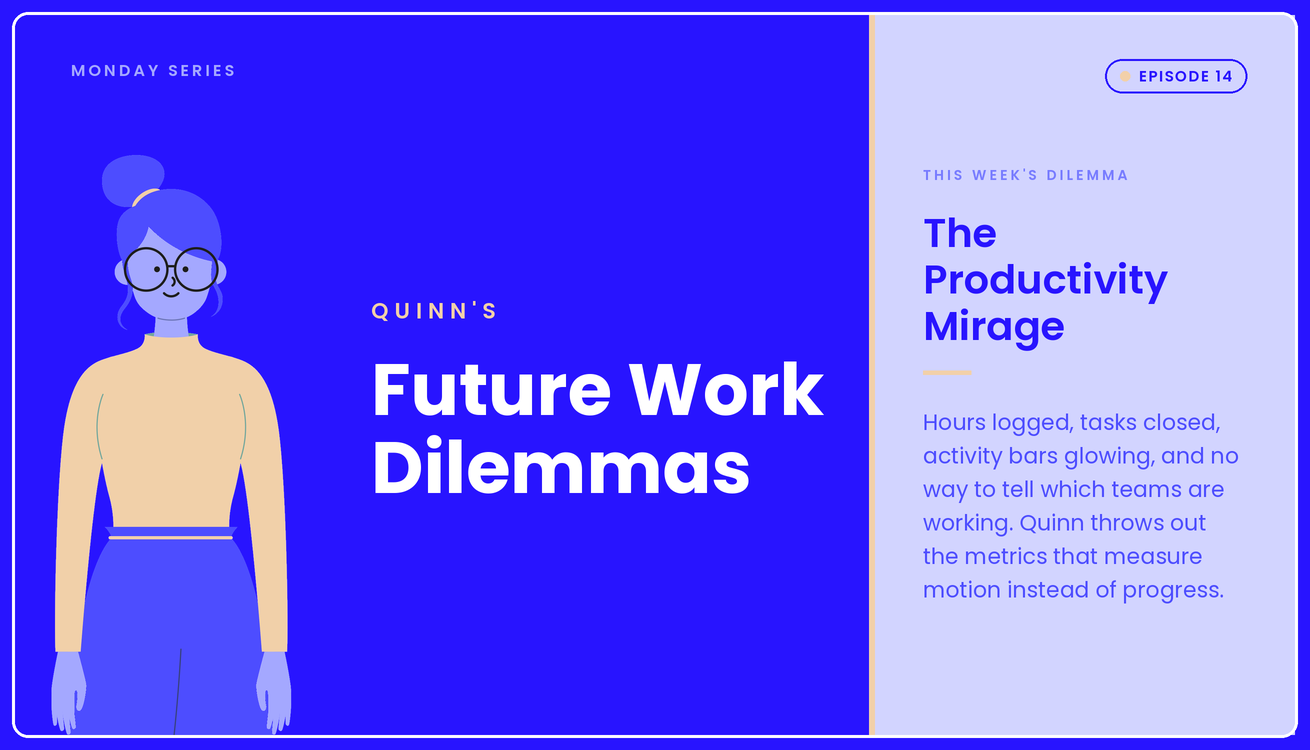

Quinn had a dashboard full of numbers and no idea which teams were working.
Hours logged. Tasks closed. Activity bars, all of them green. Every measure the platform offered was present, and not one of them answered the question she actually had.
Around her the hybrid teams were behaving very differently. Some were producing their best work of the year on flexible schedules. Others looked constantly busy and shipped nothing. On the dashboard, the two groups were indistinguishable.
That was the tell. The metrics were counting motion. Motion and progress had come apart, and nothing on the screen could see the gap.
"We are tracking noise," Quinn said, "not progress."
Her Slack filled with managers asking the same question in different words: what are we supposed to measure now?
What the Old Metrics Missed
Hours are an input. They tell you what something cost, never what it was worth. A team that took twice as long to build the right thing looks worse than a team that shipped the wrong thing quickly.
Task counts reward small work. Anything that can be closed in a day gets closed. The work that matters, the work that takes three weeks and no intermediate ticks, quietly stops getting picked up.
Presence signals nothing. Logged in is not engaged, and in a distributed team it is not even visible in a useful way.
What Quinn Measured Instead
Outcomes, not checklists. Not how many tasks closed. Whether the business moved, or a client's problem went away.
Team function, not attendance. How cleanly work moved between people, rather than who was online at which hour.
Capability growth. What the team could do at the end of the quarter that it could not do at the start. Skills compound; completed tickets do not.
Local ownership. Each team defined its own measure of a good week, then defended it. Teams given the question took it more seriously than teams given the answer.
Leadership Takeaways
Stop counting time. Count what the time produced.
Trust is a measurement decision. Teams given room to define good work usually set a higher bar than the one imposed on them.
Metrics should move as the work moves. A measure that has not changed in a year is measuring the company you used to be.
Quinn closed the dashboard. Real productivity is not a full day. It is a day that counted.
Teaser for Episode 15: The Connection Equation
Measurement is settled. The harder question is what holds a distributed team together once the metrics stop pretending to.
