
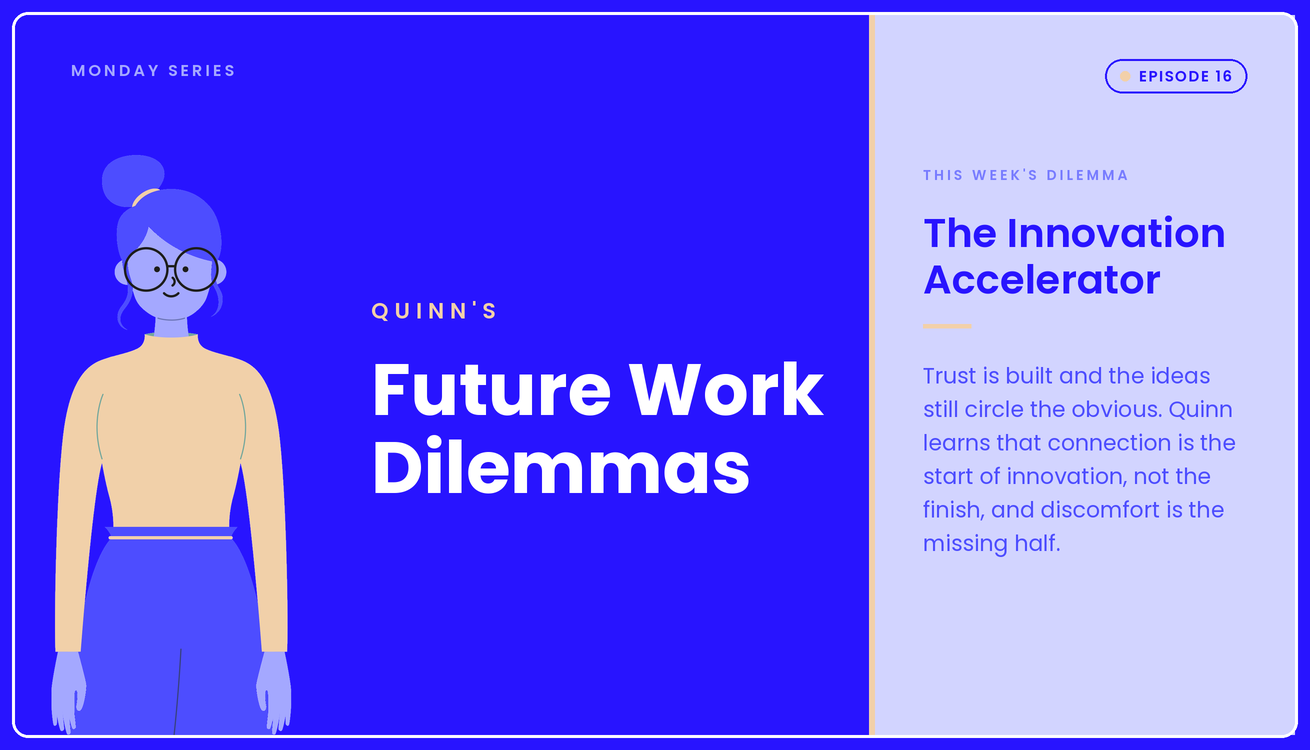

Trust is built. The team is clicking. But the ideas? Still stuck.
For Quinn, this was the frustrating part. They had done the hard work, fixed broken dynamics, and created room for honest input. But when it came time to create something new, the team kept circling the obvious.
Too polite. Too aligned. Too careful.
That is when Quinn realized: connection is not the finish line. It is the starting condition. What comes next, real innovation, requires a different kind of tension. One the team had not been taught to handle.
What Was Missing
Not creativity. Not capability. But productive discomfort, the kind that challenges assumptions without eroding trust.
Most teams avoid this because they do not know how to have sharp conversations without cutting each other down. They confuse alignment with agreement. Clarity with safety.
Quinn's team needed space to explore ideas before they were polished, and a culture where debate was not seen as dissent.
So she started changing the conditions, not the people.
What She Put In Place
Sandbox hours. No agenda. No KPIs. Just time carved out for the team to explore a problem from all sides. Some ideas were bad. Others made no sense. But one small thread turned into something they never would have found in a meeting.
Pre-mortems before greenlights. Before moving forward, every team member had to play devil's advocate. What could go wrong? What is still unclear? This did not kill ideas. It made them stronger.
Neutral zones for wild input. Some ideas are hard to say in a room full of hierarchy. Quinn set up private backchannels and anonymous drop-ins, not because people were afraid, but because they needed time to form thoughts that were not yet defendable.
Slow yes, fast no. She gave breathing room to ideas that needed to simmer, but quickly shut down the ones that did not move the needle. No drawn-out maybe piles. Clarity helps everyone focus.
What Leaders Get Wrong About Innovation
Too many treat it like a motivational problem. More encouragement. More vision. More slogans.
But most people are not blocked by fear. They are blocked by systems that punish uncertainty and reward consensus.
If there is no room for complexity, there is no room for real thinking.
Quinn's Takeaway
Innovation does not happen because you asked for it. It happens because you built the conditions that let it emerge. Ideas do not need hype. They need patience, friction, and the right kind of air.
Teaser for Episode 17: The Invisible Load
Just as momentum builds, something stalls again, not in the ideas, but in the energy. Quinn starts noticing a pattern: the team is not burning out from work. They are burning out from everything around the work. Decision fatigue. Context switching. Constant emotional buffering.
