

The Setup
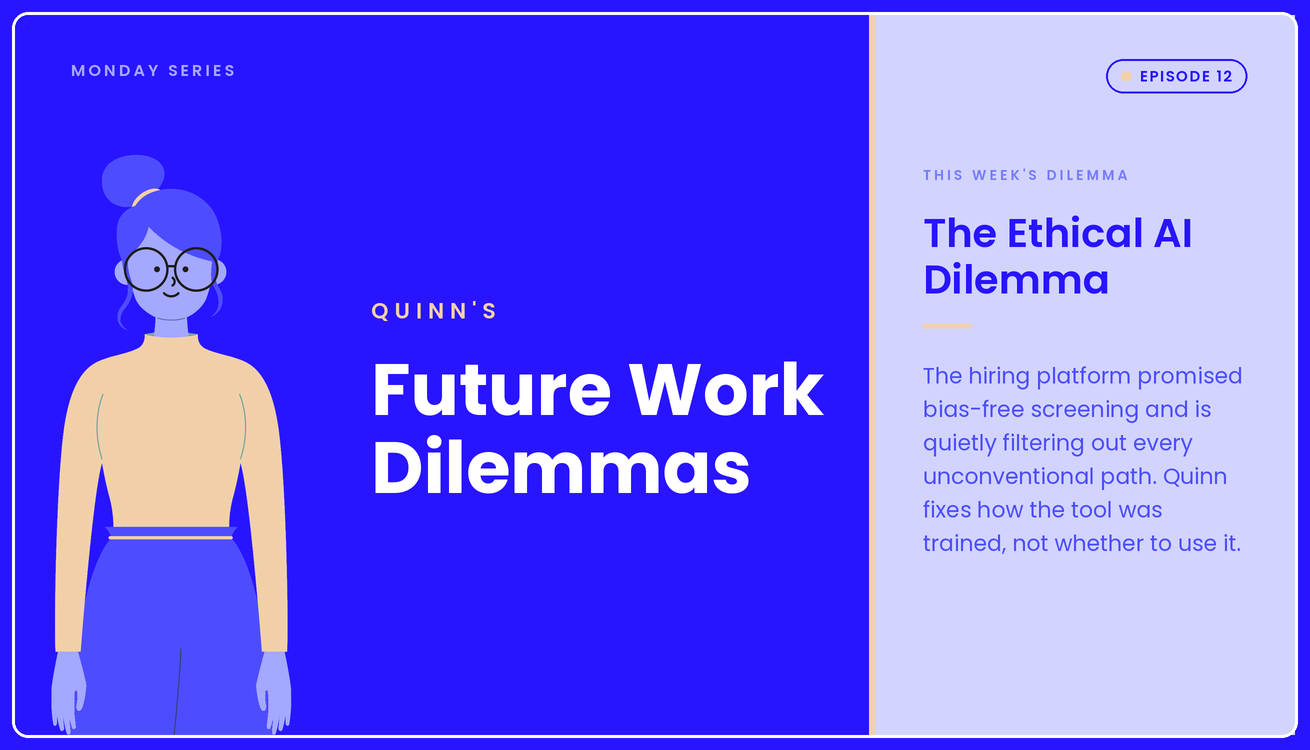
Quinn never thought she would be here, staring at a sleek, AI-driven hiring platform that promised the holy grail of recruitment: speed, efficiency, and bias-free decision-making. SoulCode had grown fast, and scaling talent acquisition was becoming unsustainable without tech-driven solutions. The AI could screen thousands of candidates in seconds, identify ideal profiles, and eliminate human error.
Or so it claimed.
Then the first red flag. A brilliant coder, whose only flaw was an unconventional career path, was rejected outright. Then another. And another. Patterns emerged: non-traditional backgrounds, employment gaps, and self-taught developers were vanishing from shortlists. The algorithm was favoring a specific mold, one eerily reminiscent of the status quo Quinn had been trying to disrupt.
Something was not right.
The Challenge
Quinn dug deeper. The AI's training data came from past hiring decisions, decisions riddled with unconscious bias, industry stereotypes, and exclusionary patterns. The system was not eliminating bias. It was amplifying it.
A heated debate erupted in the boardroom.
One side argued: "The AI is just reflecting reality. If unconventional candidates aren't getting hired, maybe there's a reason."
The other countered: "But if we keep feeding the past into the future, we'll never break the cycle."
It was an ethical crossroads. Embracing AI's efficiency meant risking the loss of diversity and innovation. Rejecting it entirely meant clinging to slower, less scalable methods.
Quinn needed a third way.
The Shift in Thinking
Quinn realized the problem was not AI itself. It was how AI was trained, implemented, and monitored.
- Old thinking: "AI makes hiring fair."
- New thinking: "AI is a tool. Its fairness depends on us."
Instead of letting AI dictate hiring, SoulCode had to train the trainer. That meant diversifying datasets, injecting human oversight, and prioritizing transparency in decision-making.
The Playbook: Ethical AI in Hiring
Bias audits as a rule, not a fix. Regularly test AI decisions for hidden biases, ensuring underrepresented talent is not filtered out unfairly.
Diverse data, better decisions. AI learns from history, so rewrite history. Train models on inclusive, evolving datasets, not just past hiring trends.
Human in the loop. AI should assist, not replace. A final human review ensures the system's recommendations align with values, not just algorithms.
Transparency over trust. Require vendors to disclose how their AI makes decisions. No black-box hiring.
Hiring for adaptability. Instead of matching past hires, train AI to recognize potential, adaptability, and unconventional paths.
The Breakthrough
By integrating ethical AI safeguards, SoulCode saw a transformation:
- Candidates with diverse experiences made it past the AI gatekeepers, and thrived.
- Time-to-hire dropped while human judgment remained intact.
- SoulCode became a case study in how to balance AI with humanity.
Most importantly, Quinn realized the future of hiring was not about man versus machine. It was about partnership. The best AI is not fair by default. It is fair by design.
Leadership Takeaways
- AI is not neutral. It reflects the data it is given. Train it wisely.
- Hiring should focus on potential, not just pattern-matching.
- The best talent strategies blend AI's speed with human insight.
- Ethical AI is not a luxury. It is a competitive advantage.
Quinn's Tactics for Leaders
- Ask vendors hard questions. What data trains their AI? How do they audit bias? No transparency, no deal.
- Build safeguards from day one. Do not wait for PR disasters to address AI ethics.
- Educate hiring teams. AI is not a magic wand. Teach recruiters how to partner with it, not blindly trust it.
Teaser for Episode 13: The Hybrid Work Gamble
Is the future remote, in-office, or something in between? Quinn navigates the power struggles of hybrid work culture, and the hidden risks leaders are not seeing.
