
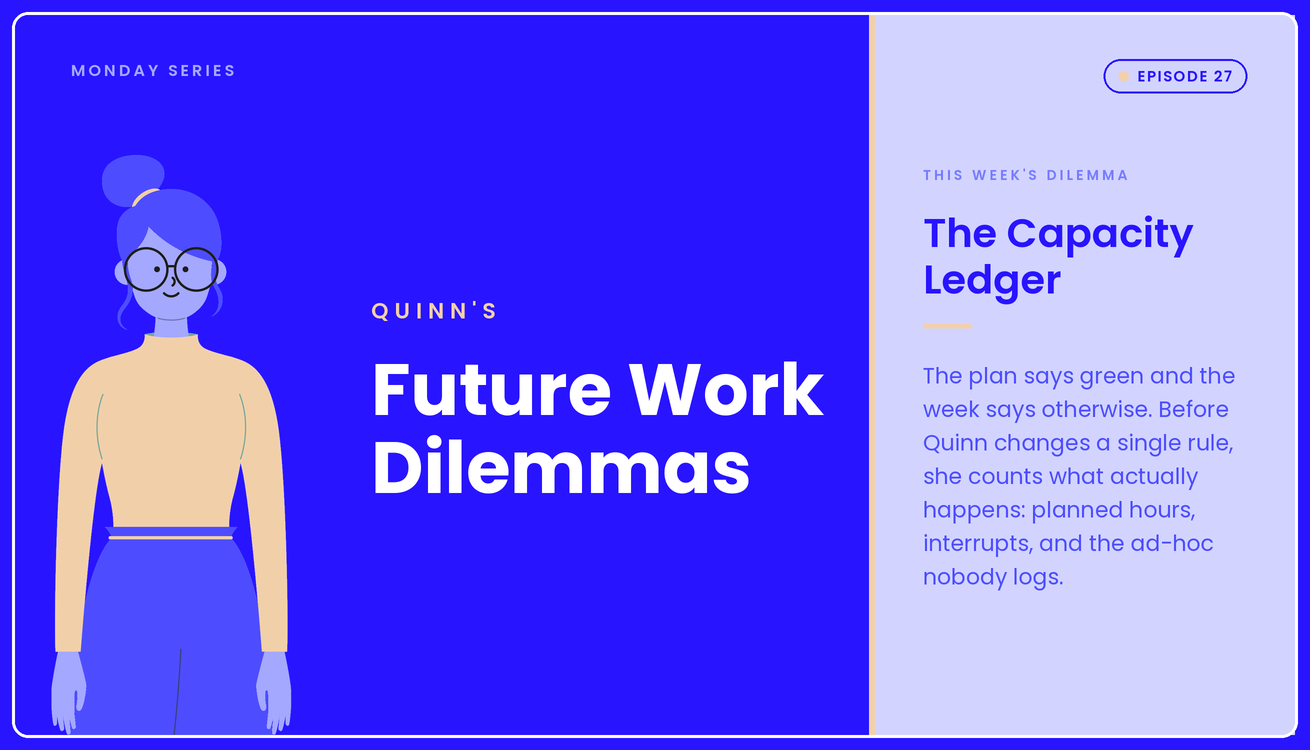

The fracture you can’t see
The plan says green. The calendar says crowded.
Interrupts arrive through every side door: customer pings, exec drive-bys, dependency surprises.
Ad-hoc feels harmless in the moment. It compounds across a week.
Context switching taxes every estimate until timelines wobble.
Nobody is slacking. The system is uncounted.
Quinn’s move: surface reality before enforcing rules. Count what actually happens. Then change how work enters and moves.
The receipts before the rules
Quinn starts with evidence. One week. No judgment.
- Capacity receipts: each person marks hours as Planned, Interrupt, Ad-hoc.
- Calendar trace: recurring meetings and status time tagged as Operating Cost.
- Entry path scan: list how new work shows up and who can say yes.
- Change log: every mid-week change gets a one-line receipt with who/why/when.
Patterns appear fast: the interrupt band is bigger than the plan. Ad-hoc slips through because it is “small.” Status time blooms when the plan drifts.
The Capacity Ledger (how it works)
A single, living page per team. Updated weekly. Visible to all.
- Baseline load: 60 to 70% reserved for planned work. Name the hours. Do not exceed.
- Interrupt tax: fixed weekly band for interrupts. If it fills, trade-offs happen.
- Ad-hoc cap: a small, explicit ceiling. Overages roll forward, not sideways.
- Freeze windows: once the week starts, changes travel one path with one owner and a response timer.
- Commit rules: each planned item has entry criteria, estimate range, owner, and acceptance proof.
- Decision log: changes recorded with receipts, timestamps, and the decision owner.
The ledger is not a dashboard. It is an operating contract grounded in receipts.
The weekly cadence
Monday set: Fill the baseline with planned work only. Publish interrupt/ad-hoc caps.
Midweek control: All new work follows the single path. Exceptions are documented.
Friday review: Compare plan vs receipts. Tune the bands. Log deltas and decisions.
What leaders manage (not micromanage)
- Trade-offs in daylight: When the interrupt band is full, something gives. Decide once, visibly.
- Owner and path: One path in, one owner, one timer. No parallel overrides.
- Focus protection: Freeze windows keep hands steady. Exceptions are rare and recorded.
- Signal integrity: Stop reading velocity alone. Track plan reliability and overage patterns.
Evidence you can track (starter set)
- Plan reliability: planned items delivered / planned items committed.
- Interrupt share: interrupt hours / total hours.
- Ad-hoc overage: hours beyond the cap; show the delta.
- Throughput per planned hour: delivered units / planned hours.
- Receipts rate: % of individuals with complete receipts by week’s end.
- Decision time: median time from new ask → accept/deflect decision.
Implementation notes (what actually helps)
- Start small: one team, two weeks, ruthless clarity.
- Name the bands: numbers beat vibes. Tune after two cycles.
- Publish the rules: write the entry criteria and freeze windows in plain language.
- Train the path owner: authority to say “not this week” with alternatives.
- Review with receipts: show before/after charts in the same view as decisions.
What changes when it works
- Plans fit inside the week.
- Ad-hoc stops hijacking focus.
- Interrupts are priced, not ignored.
- Status meetings shrink; decision logs grow.
- Predictability climbs; blame loops fade.
Cheat sheet (print and tape up)
Baseline load. Interrupt tax. Ad-hoc cap. Freeze windows.
One path. One owner. One timer. Decision logged with receipts.
Quinn’s note to operators: Treat capacity like cash. Budget it. Track it. Defend it.
Next Episode: The Proofline Dashboard
A compact, receipts-first view of Receipts Rate, Lane Integrity, and Decision Velocity, refreshed monthly so leaders steer with evidence, not noise.
Every other Monday
Quinn works through one hiring dilemma at a time. Leave an address and the next one arrives when it is written.
 ©2026 Talent Gurus Inc. All rights reserved.