
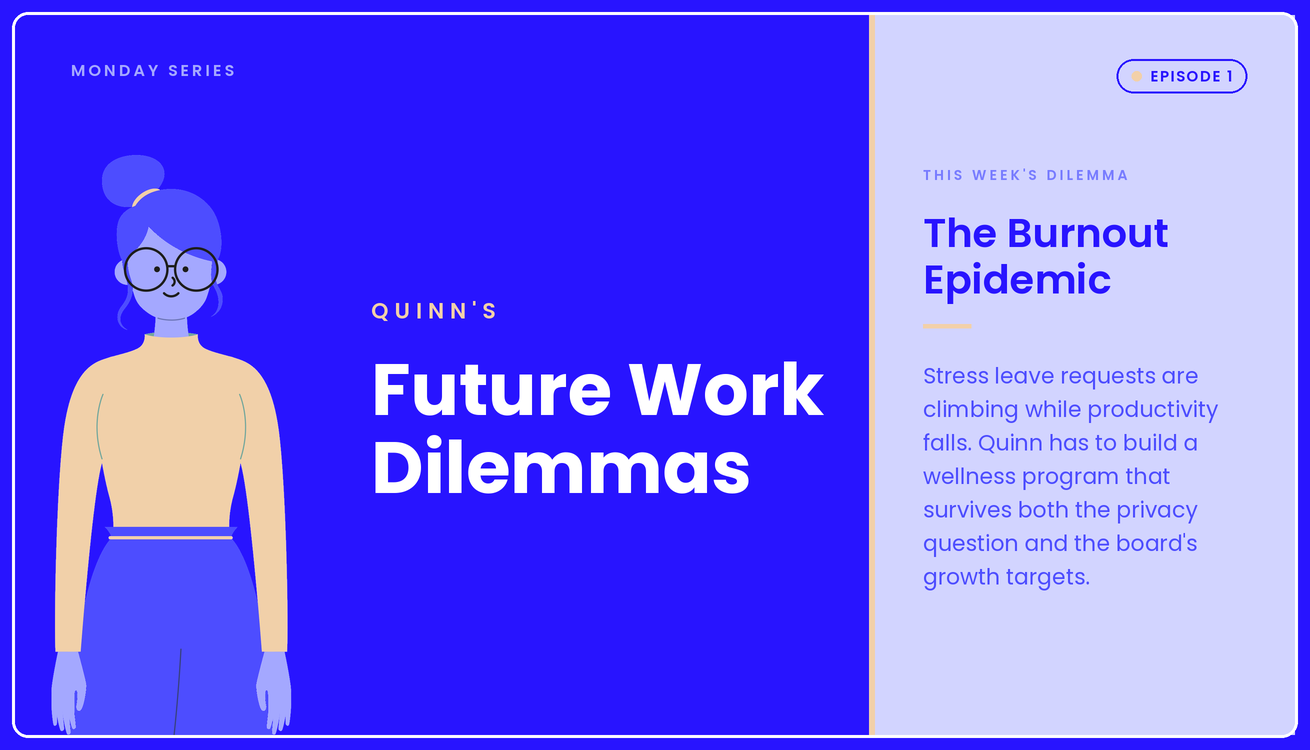

Quinn is HR Director of FuturaPulse Enterprises. In a world where AI assistants are colleagues and holographic meetings are the norm, her job is the balance between what the technology can do and what the people can carry. This is where the series starts.
Quinn's smartwatch gently vibrates, its soft blue glow illuminating her face. As her eyes flutter open, the watch projects a holographic display:
"ALERT: 3 New Stress Leave Requests" "Meeting in 90 minutes: Quarterly Results"
Quinn sighs, running a hand through her hair. "Another day in paradise," she mutters, her voice activating her home AI.
"Good morning, Quinn," the AI chirps. "Your stress levels are elevated. Shall I schedule a meditation session?"
"No time," Quinn replies, swinging her legs out of bed. "Just the usual morning brief, please."
As Quinn goes through her morning routine, the AI's voice follows her:
"Global headlines: 'Work-Life Balance: The New Corporate Currency'... 'Tech Giants Face Exodus Over Burnout'... 'Is the 4-Day Work Week the Answer?'"
Quinn pauses, toothbrush in hand. "Looks like I'm not the only one dealing with this," she muses.
Moments later, her home office materializes around her.
Quinn sits at her desk, surrounded by floating holographic screens. She swipes through employee data, frowning at the trends.
"Computer, show me the correlation between our new hybrid work model and reported stress levels."
A graph materializes, showing a clear upward trend.
"Now overlay productivity metrics."
The new line shows a steady decline.
"Well, that's not good," Quinn murmurs.
Key Takeaways for Today's Leaders: Identifying Burnout Early
- Use data to spot trends.
- Combine qualitative and quantitative insights.
- Implement employee feedback loops.
Her watch buzzes again. "Incoming call: CEO"
Quinn takes a deep breath and accepts the call. A holographic bust of Sarah, the CEO, appears.
"Quinn, I hope you're ready for this meeting. The board is breathing down my neck about these numbers."
"I'm on it, Sarah. I think I have a plan, but..."
Sarah cuts her off. "No 'buts', Quinn. We need solutions, not problems. See you in an hour."
The call ends abruptly, leaving Quinn staring at the space where Sarah's image was.
Key Takeaways for Today's Leaders: Presenting Solutions to Leadership
- Frame problems with potential solutions.
- Leverage predictive analytics.
- Align solutions with business goals.
Sixty minutes and countless data simulations later, Quinn's office morphs into a virtual conference room. She takes a deep breath, straightens her posture, and nods to activate the meeting space.
Quinn stands before a semi-circle of holographic executives, her presentation floating in the air around her.
"As you can see," she gestures to a 3D model of their office layout, now mostly empty, "our transition to hybrid work has had unexpected consequences. We've increased flexibility, but we've lost the spontaneous interactions that fueled our creativity and team spirit."
The CTO's avatar leans forward. "But the new collaboration tools should be making up for that. We invested millions in this tech!"
Quinn nods, pulling up another hologram. "The tools are excellent, but look here," she zooms in on an employee's brain scan, "constant digital communication is actually increasing stress levels. We're always 'on', and it's burning people out."
Murmurs ripple through the virtual room.
"So what do you propose?" Sarah asks, her avatar's expression unreadable.
Quinn takes a deep breath. "A comprehensive wellness program. One that combines flexible hours, enhanced mental health support, and, here's the kicker, AI-powered workload distribution."
She gestures to a holographic chart. "Imagine AI that doesn't just schedule our work, but understands our wellbeing. It could predict burnout before it happens and adjust in real-time."
Key Takeaways for Today's Leaders: Implementing AI for Wellness
- Start small with AI tools.
- Ensure transparency and privacy.
- Test and iterate.
The room fills with a mix of excited murmurs and skeptical frowns.
"Is this even possible?" The CFO's avatar leans forward, eyes narrowed.
Quinn nods. "Parts of it are already in play. We're just pushing it further. Flexible hours? That's today. AI analyzing work patterns to support mental health? We're nearly there. Full AI workload balancing? That's our moonshot."
As Quinn fields the barrage of questions, her mind races. "This has to work," she thinks. "The future of our workplace depends on it, and so does my own wellbeing."
Key Takeaways for Today's Leaders: Building a Comprehensive Wellness Program
- Integrate flexible work options.
- Enhance mental health support.
- Workload management tools.
Quinn's Dilemma
How can Quinn develop a wellness program that:
- Supports mental health across diverse work arrangements
- Respects employee privacy
- Maintains productivity
- Satisfies leadership's growth expectations
- Balances immediate implementation with long-term innovation
Teaser for Episode 2: The Unexpected Ripple Effect
Just when Quinn thinks she's found a solution to workplace burnout, an unexpected consequence of the new wellness program sends shockwaves through FuturaPulse Enterprises. With top talent flocking to join their ranks and social media ablaze, Quinn must navigate a new dilemma: is this sudden popularity a golden opportunity or a ticking time bomb?
