
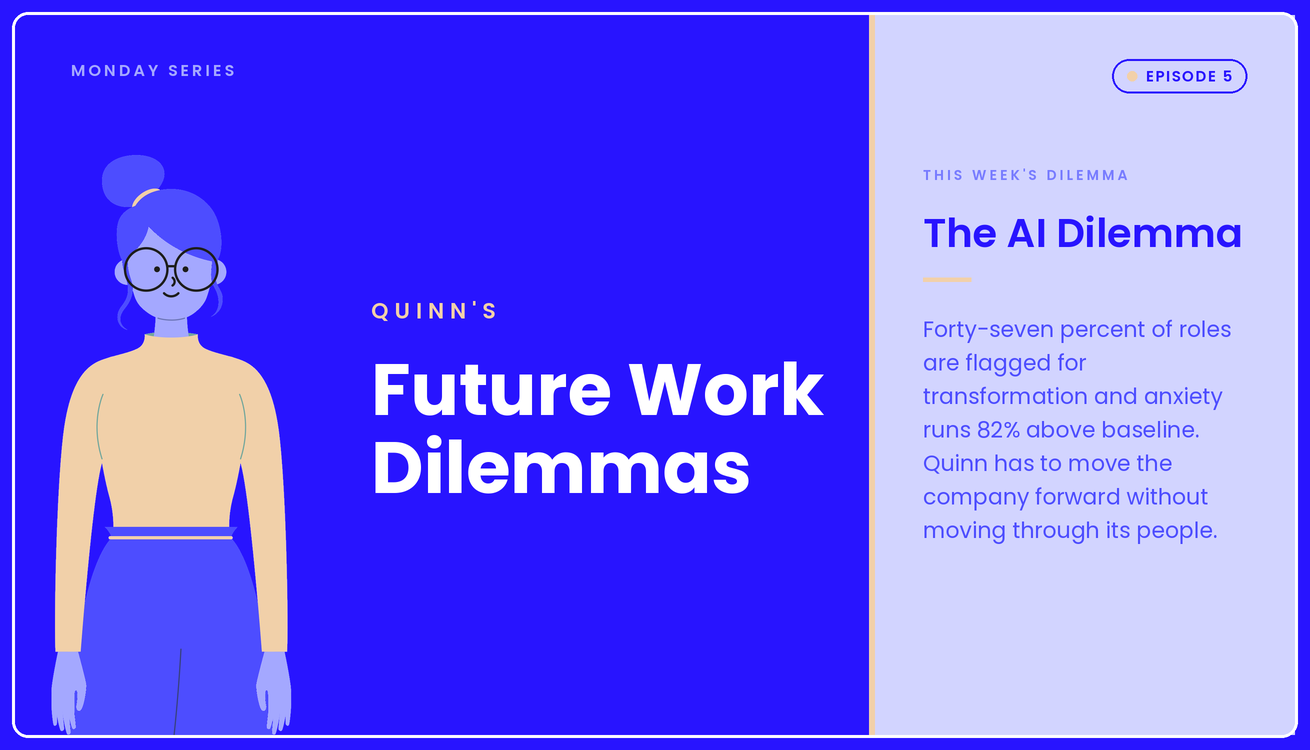

The Morning Alert
Quinn's morning starts with an unexpected jolt. Instead of AIDA's usual soft wake-up, she's greeted by a pulsing red notification:
"ALERT: AI Integration Phase 1 Complete. 47% of current job roles flagged for significant transformation."
Quinn bolts upright, heart racing. She'd known this day was coming. The company's major AI upgrade had been in the works for months. But seeing the hard numbers, her mind races, caught between anticipation and dread. This wasn't just a new phase. It was a reckoning.
"AIDA," she says, voice steady but tense, "show me the detailed impact assessment."
Instantly, holographic charts light up before her, each one more troubling than the last. Traditional roles across departments flash in warning red, while new hybrid positions, blending human insight with AI capabilities, glow in a hesitant yellow.
"And the employee sentiment analysis?" Quinn asks.
"Anxiety levels are 82% above baseline," AIDA responds. "Internal message boards show a 300% increase in job security concerns."
Quinn closes her eyes, taking a deep breath. "So much for easing into the week."
The Leadership Divide
In the executive lounge, Quinn finds Sarah in a quiet but heated discussion with Marcus, the new Chief Technology Officer. The air is thick with tension.
"Look at these efficiency metrics!" Marcus gestures excitedly at a hovering display. "The AI systems are already surpassing expectations. We could accelerate the timeline..."
"And what about our people?" Quinn interrupts, making both executives look up. "Have you seen the anxiety levels among our workforce?"
Sarah's gaze falters. "Quinn, there's a competitive advantage here. Other companies are moving faster..."
"We'll move forward too," Quinn replies, voice steady, "but not at the expense of our people's wellbeing. We're just stabilizing after the parental support initiative. A balanced approach is crucial."
The Human Factor
Later, Quinn walks through the office, now a landscape of both human and AI interactions. Some employees engage seamlessly with their AI assistants, while others cast wary glances at the new systems.
She pauses by Maya's desk, a veteran account manager whose role has been flagged for "AI enhancement." Maya's hands shake slightly as she fumbles with the unfamiliar interface.
"I've been here fifteen years," Maya says, her voice barely a whisper. "But now I feel obsolete."
A pang of empathy grips Quinn. This is the real cost of progress: the fear, the sense of displacement. But it doesn't have to be this way.
The Human-AI Harmony Initiative
Back in her office, Quinn starts developing a comprehensive plan that she dubs the Human-AI Harmony Initiative.
Skills Evolution Program
- AI literacy training for all employees.
- Personalized learning paths for roles undergoing transformation.
- Focus on uniquely human skills: creativity, emotional intelligence, complex problem-solving.
AI-Human Collaboration Framework
- Clear delineation of AI and human responsibilities.
- Emphasis on AI as enhancement, not replacement.
- Recognition systems for successful human-AI partnerships.
Transition Support System
- Career counseling and role exploration.
- Mental health resources to help manage technological change.
- Peer support networks and success stories.
Ethical AI Governance
- Employee involvement in AI implementation decisions.
- Transparent communication on AI capabilities and limitations.
- Regular ethical reviews of AI's impact on workforce wellbeing.
Future-Ready Leadership Training
- Managing hybrid human-AI teams.
- Emotional intelligence for leading through automation.
- Creating psychological safety during transformations.
The Presentation
Quinn stands before the board, taking a deep breath. Around her, holographic displays show the human side of their AI transformation: stories of successful transitions, metrics on employee wellbeing, and the long-term benefits of a balanced approach.
"We're not choosing between progress and people," she begins. "We're choosing how to progress while empowering our people. Our AI systems are incredible tools, but they're just that, tools. Our competitive advantage doesn't lie in having the latest AI. It lies in fostering the most effective human-AI collaboration."
She activates a new visualization: a double helix of AI capabilities and human potential, intertwined to create something far greater than the sum of its parts.
"This is our opportunity to lead. Not just in technology, but in human-centric digital transformation."
The room falls silent as board members exchange glances. Finally, Sarah speaks.
"Quinn's right. We need both the technological leap and the human touch. This isn't just about surviving the transition. It's about thriving through it. Let's show the industry what responsible AI integration looks like."
Teaser for Episode 6: The Culture Clash
Just as FuturaPulse finds its rhythm with AI integration, a new challenge arises. With the company's rapid global expansion, a clash of workplace cultures emerges. Can Quinn bridge the gap between different cultural approaches to AI adoption and workplace automation?
